Sleep
White noise machines vs sleep plush toys: what actually helps a baby sleep
They solve different problems, and one of them isn't safe in a crib until your baby's first birthday. Here is how each works, and what suits which age.


On this page
White noise machines and sleep plush toys get compared as if they were two answers to the same question. They aren't. White noise is about sound: masking the household noises that wake a light sleeper. A plush toy is about comfort: something familiar to hold. And the biggest difference between them isn't which works better. It is that one of them doesn't belong in a baby's crib at all until they are a year old.
First, the safe sleep part
The American Academy of Pediatrics recommends that for the first 12 months, a baby's sleep space holds nothing but a firm, flat mattress and a fitted sheet. No pillows, no blankets, no bumpers, and no soft toys, however small. Soft objects can cover a baby's face and raise the risk of suffocation and sleep-related death.
That rules out most "sleep plush toys" for babies: the teddy with a heartbeat sound, the glowing sheep, the comforter blanket with a toy's head. They can be lovely for cuddles while your baby is awake, but they come out of the crib at sleep time until after the first birthday. That includes the plush comforters we sell.
What white noise does
White noise is a steady, even sound, like a fan or the hiss between radio stations. Brown and pink noise are the same idea with more low notes, so they sound deeper, more like rain or distant surf. For a baby's purposes they do the same job: they blur sudden noises, like a door, a dog or a sibling, that would otherwise stand out against silence.
There is some evidence it helps. In a small study from 1990, 16 of 20 newborns played white noise fell asleep within five minutes, compared with 5 of 20 who weren't. It is one small, old study, but it matches what many parents see: newborns spent months in a loud womb, and a steady sound seems to settle them.
What white noise doesn't do is fix sleep that is hard for other reasons, like hunger, overtiredness or a room that is too warm. It helps a baby who is ready to sleep stay asleep through a noisy house.
How loud is too loud
This matters more than which machine you choose. A 2014 study in Pediatrics tested 14 infant sleep machines and found that at full volume, every one of them was louder than the 50-decibel limit recommended for hospital nurseries, measured 30 cm (about a foot) away, and three were loud enough to risk damaging hearing over time. The authors' advice, plus the usual rule about cords:
- Put the machine as far from the crib as the room allows, never in or on it
- Keep the volume low, well below the level of normal conversation
- Use a timer, or turn it off once your baby is asleep, rather than running it all night at volume
- Keep the cord well out of reach, at least three feet from the crib
A useful check: stand by the crib. If you would have to raise your voice to talk over the sound, it is too loud.
What a comfort toy does
A comfort object, whether a small soft toy, a lovey or a scrap of blanket, helps a child settle through touch and familiarity. It becomes a portable piece of home, which is why it works so well in new places: at a grandparent's house, at daycare, on holiday. Many toddlers choose one themselves and attach to it fiercely.
After the first birthday, when the risk of sleep-related death has dropped a long way, pediatricians generally consider a small, light comfort object in the crib reasonable; if you're unsure, ask your pediatrician. Pick something small, without buttons, beads or long ribbons, without batteries or electronics, and without long pile that sheds. Buy two if your child gets attached, and rotate them through the wash. Every parent who has lost the only one on a day out knows why.
Which suits which age
| Age | White noise | Comfort toy |
|---|---|---|
| 0 to 12 months | Can help, especially with newborns and in noisy homes. Low volume, well away from the crib. | Not in the crib. Fine for cuddles and play while awake and supervised. |
| 12 months to 3 years | Optional. Useful for naps in a busy house and for travel. | A small lovey in the crib is generally fine now, and often helps with separation. |
| 3 years and up | Some children still like it; there's no need to stop if it helps. | Often the main sleep comfort by now, and very useful for new places. |
Using both
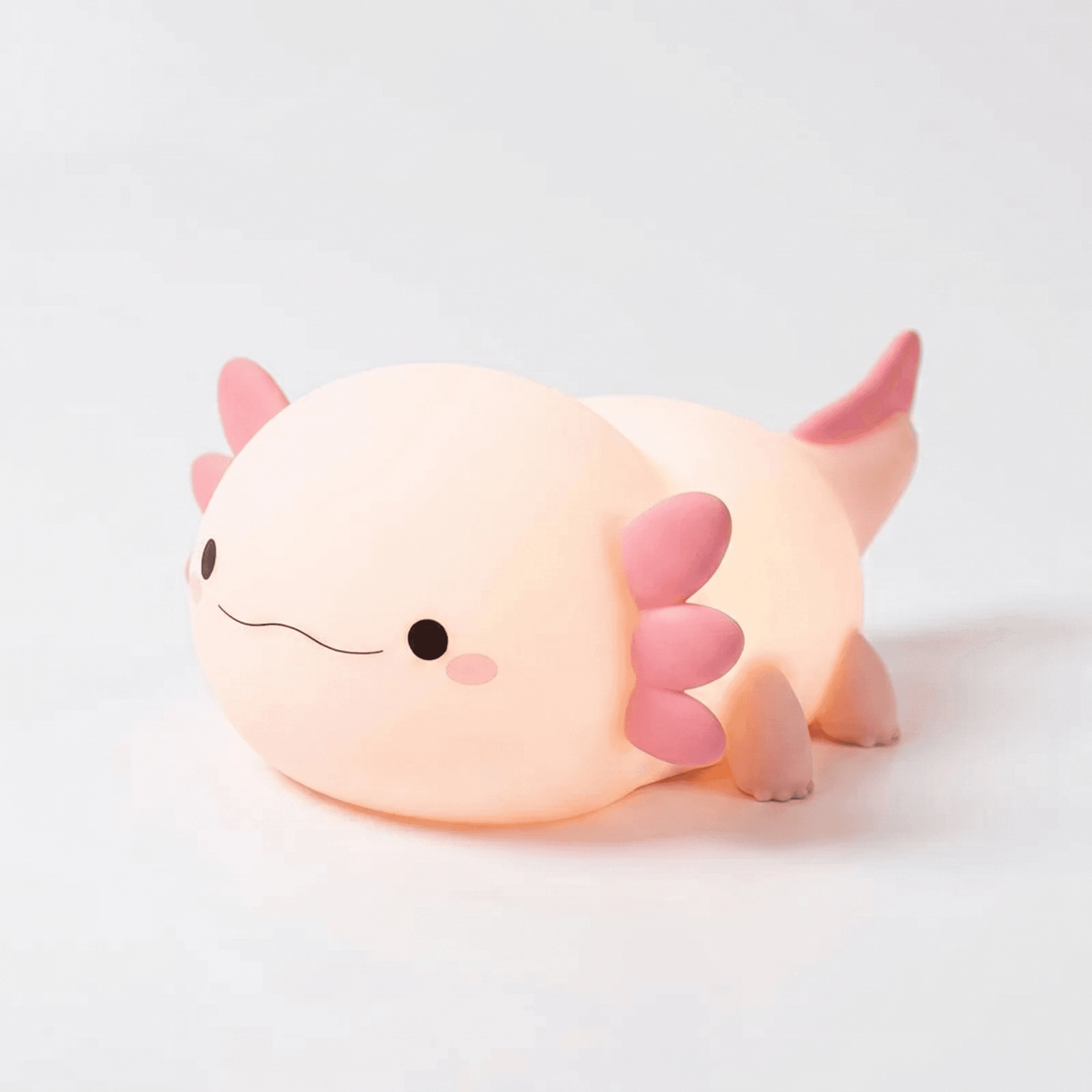
For a toddler, the two work well together: steady sound in the background, something to hold in bed, and the same bedtime routine every night. Keep the rest of the room calm. A dim, warm light is enough for night feeds and changes; a bright or color-changing light near bedtime works against sleep. Our axolotl night light dims and has a 30-minute timer, so it can see a toddler through a story and turn itself off. It has color-changing modes too; at bedtime, pick one steady, warm color at a low setting and save the rainbow for daytime. It runs on a rechargeable battery, so there is no cord, but like anything else it belongs on a shelf, not in the crib.
When you want to stop using white noise, turn it down a little every few nights rather than switching it off. Most children barely notice.
What we sell, and what we don't
We don't sell a white noise machine at the moment. A fan, an app on an old phone left across the room, or any simple machine with a volume control and a timer will do the job, as long as you follow the volume advice above.
We do sell plush comforters and bear loveys, and they are lovely: for awake time and play, and for the crib once your child turns one. For babies under a year, the thing that goes in the crib with them is a sleep sack, and before rolling starts, a swaddle; we have a separate guide on swaddling safely and when to stop.
Sources
About this piece. We sell some of the things mentioned here, and we’ve tried to be straight about when they aren’t the right choice. Health and safety points follow the sources above. They are general guidance, not medical advice about your child.
The things we mention

More from the journal
How to swaddle safely, and when to stop
Swaddling can settle a newborn beautifully. It also comes with a short list of rules that matter a great deal, and a firm end date.
Starting solids: the gear that helps, and what you can skip
You need less than the baby aisle suggests: a safe seat, a soft spoon, something the food can't slide off, and something to catch what falls.
Babyproofing, room by room: what to do first
Most babyproofing lists treat a corner guard and an unanchored dresser as equal. They aren't. This one starts with the jobs that prevent the worst injuries.